Short-term rental insurance in Arizona runs roughly $2,500–$8,000+ per year for most properties — below the coastal hurricane states, but with cost drivers competitors’ guides miss. Three Arizona-specific factors shape pricing: the summer monsoon’s microburst wind and flash-flood exposure, the extreme heat that stresses HVAC systems and wears outdoor amenities hard, and Wildland-Urban Interface wildfire exposure in the high country. Here are the real numbers and what moves them.
The Arizona-Specific Cost Drivers Other Guides Miss
Most STR cost guides treat Arizona as a low-cost, low-risk state and stop there. That misses how Arizona property actually underwrites. For the drivers every state shares before the local ones kick in, see our national STR insurance cost guide.
The first driver is the summer monsoon. From roughly June through September, Arizona’s monsoon produces microburst winds that can hit like a small storm, blowing dust, and intense flash flooding. Wind and wind-driven rain are generally covered under a property policy; flooding is not — and a property near a wash or in a low-lying area has real flash-flood exposure even though Arizona has no coastline. FloodSmart explains how that separate coverage is written.
The second driver is extreme heat and amenity stress. Phoenix-area summers run HVAC systems near their limits for months, and outdoor amenities — pool decking, pool equipment, artificial turf, ramadas — wear faster than they would in a milder climate. Heat itself isn’t an insured peril, but it drives the failure rate of the equipment a property depends on, which is why equipment breakdown coverage is more relevant on an Arizona STR than most hosts assume. And pools — central to the Phoenix and Scottsdale STR markets — are the single amenity that moves general liability cost most.
The third driver is high-country wildfire. Arizona is not all desert: Flagstaff, Prescott, Sedona, and the forested high country sit in real Wildland-Urban Interface territory, with the Coconino National Forest and Tonto National Forest nearby. An STR in those areas carries wildfire exposure that prices much closer to a Colorado mountain property than to a Phoenix listing. The Insurance Information Institute’s wildfire facts and its background on wildfires document the pattern. On the regulatory side, Arizona governs short-term rentals through a state statutory framework — ARS § 9-500.39 — that sets the boundaries within which Scottsdale, Sedona, and other municipalities run their licensing programs; the Arizona Department of Insurance and Financial Institutions oversees the carriers.
Real Cost Ranges We See in Arizona
In our experience placing Arizona STR coverage, annual premium for a full program — general liability, dwelling, loss of rents, and contents — typically falls in these ranges:
- Phoenix Metro and Tucson urban STR: roughly $2,500–$5,000/year
- Scottsdale pool property: roughly $3,500–$6,500/year
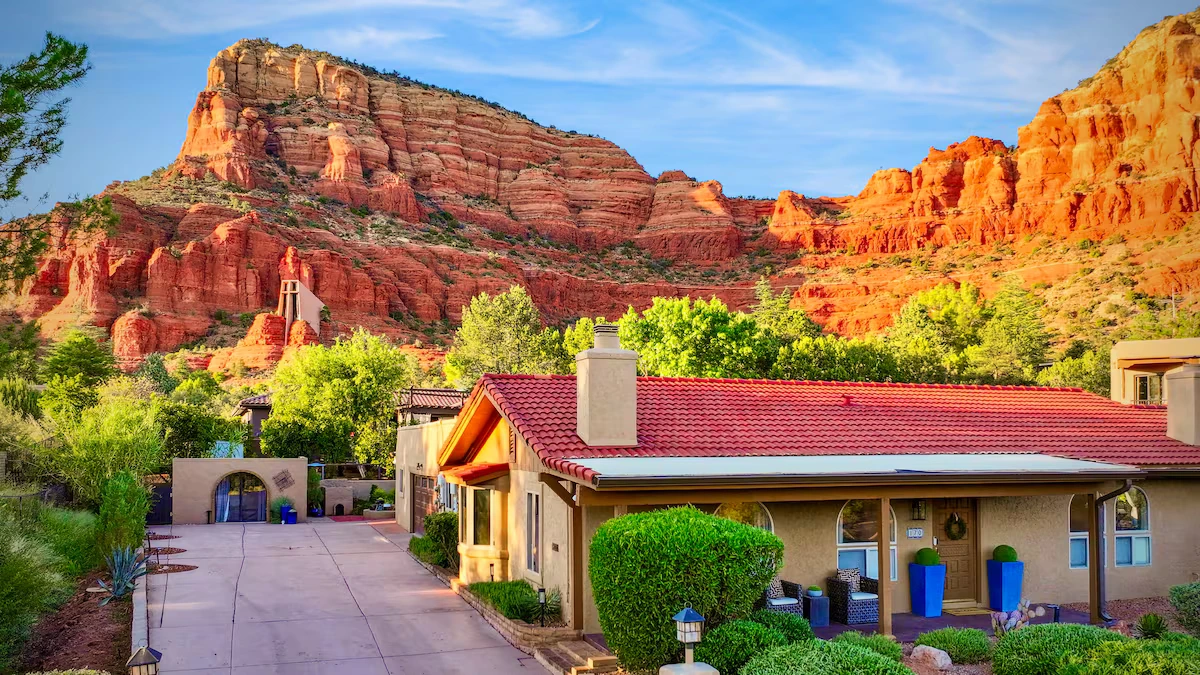
- Sedona vacation home: roughly $3,500–$7,000/year
- High-country STR (Flagstaff, Prescott) with WUI exposure: roughly $3,000–$6,500/year
- High-value resort or large estate property: frequently $8,000+/year
These are program ranges. Arizona avoids the percentage named-storm deductibles of the coastal states, but high-country properties in mapped wildfire areas can carry a wildfire deductible, and pool liability lifts the general liability line across the desert markets. We don’t quote off a calculator — Arizona placements run the property’s location, amenity profile, and construction through the specialty carrier panel.
Scenario: $900K Pool Home in Old Town Scottsdale
We recently helped a host with a $900K, 4-bedroom home near Old Town Scottsdale — 8-guest capacity, a pool and spa, artificial turf, a covered ramada. The property earns roughly $110K/year on Airbnb and VRBO, with demand concentrated in the cooler winter and spring months and around major Scottsdale events. The owner had it on a standard homeowners policy that excluded the commercial rental use entirely, with a general liability position that never contemplated a pool open to paying guests.
We rebuilt the program on a dwelling form built for a non-owner-occupied short-term rental, with general liability sized specifically for the pool-and-spa amenity profile, and we added equipment breakdown coverage — an Arizona summer is hard on HVAC and pool equipment, and a mid-July system failure can make a property unrentable fast. Annual premium across GL, dwelling, loss of rents, and contents came to roughly $4,800. The pool was the line item that moved general liability most; a comparable home without a pool would have come in several hundred dollars lower. We also confirmed the property was operating under a valid Scottsdale STR license, because an unpermitted listing complicates a claim.
Cost by Coverage Type in Arizona
An Arizona STR program is built from several coverage lines, each priced on its own logic.
General Liability
General liability covers third-party bodily injury and property damage from guest stays — typically $1M each occurrence / $2M aggregate. In Arizona, the pool is the amenity that moves this line most; large guest capacity adds to it. See general liability for short-term rentals.
Property / Dwelling
The dwelling line covers the structure. In the high country it can carry a wildfire deductible; in the desert it covers monsoon wind and wind-driven rain damage. Replacement-cost accuracy matters. See property and dwelling coverage.
Flood
Flood is excluded from every property policy and written separately through the NFIP or a private market. Arizona has no coast, but monsoon flash flooding is real — wash-adjacent and low-lying properties should carry it. See flood insurance.
Equipment Breakdown
Equipment breakdown covers the sudden mechanical or electrical failure of systems like HVAC and pool equipment. In an Arizona summer, an HVAC failure isn’t just a repair bill — it can make the property unrentable. See equipment breakdown coverage.
Loss of Rents
Loss of rents replaces rental income while a covered loss makes the property unrentable. Worth pairing with equipment breakdown in Arizona, where a peak-summer system failure can knock a property offline. See loss of rents coverage.
Umbrella / Excess
An umbrella stacks higher limits over primary GL — strongly advisable for pool properties with large guest capacity, and usually one of the most cost-efficient lines. See umbrella and excess liability.
Cost by Major Arizona Market
Arizona STR pricing varies by market more than any single statewide number can show.
Phoenix Metro
Large urban STR market — desert perils, pools, and steady winter-season demand. Pricing is moderate; the pool drives the liability line.
Scottsdale
High-demand STR market with amenity-heavy pool properties and an active municipal licensing program. Moderate-to-high pricing; pool liability is the swing factor.
Sedona
High-demand red-rock tourism market with WUI wildfire exposure and its own STR licensing program. Prices above the Phoenix urban core.
Tucson
Southern Arizona urban STR — desert perils and steady tourism. Pricing similar to the Phoenix urban core.
Flagstaff
High-country STR with genuine Wildland-Urban Interface wildfire exposure and a four-season operating model. Prices well above the desert markets.
Prescott
High-country STR with WUI wildfire exposure and milder summers. Prices in the high-country band.
Lake Havasu
Colorado River recreation market — extreme summer heat and water-recreation liability. Moderate pricing.
For the full regulatory and peril picture, see our Arizona short-term rental insurance page.
The Most Common Arizona STR Coverage Gap We See
The most common Arizona STR coverage gap is a property insured on a standard homeowners policy after it went onto a platform.
It’s the same pattern everywhere: a host buys a Phoenix or Scottsdale home, insures it on a homeowners policy, then lists it on Airbnb and VRBO. The homeowners form excludes the commercial lodging activity that defines a short-term rental. Nothing goes wrong for a season — then there’s a claim, the carrier’s investigation reveals the property was operating as an STR, and the claim is denied.
The Arizona-specific second gap is a pool property whose general liability isn’t sized for the pool. Pools are central to the desert STR markets, and they are the single largest guest-injury exposure on the property. A general liability position carried over from a homeowners policy — or set without the pool clearly in view — can leave a host badly underinsured for exactly the claim most likely to happen. We typically see this corrected by sizing GL deliberately for the pool and adding an umbrella over it.
The third gap is a wash-adjacent property with no flood policy. Because Arizona has no coast, hosts assume flood isn’t their problem — but monsoon flash flooding moves through washes and low-lying areas every summer. Flood is a separate policy, and a desert property can still need it. All three gaps share the same fix: a program placed with the property’s real use, amenities, and location fully in view.
How to Lower Your Arizona STR Insurance Costs
Arizona premium responds to several levers:
- Size the pool liability deliberately, then add an umbrella. An umbrella over a properly-sized GL position is one of the most cost-efficient ways to cover the pool exposure.
- Document pool safety. Fencing, gate alarms, posted rules, and slip-resistant decking can support better general liability pricing.
- Maintain and document HVAC and pool equipment. Service records support equipment breakdown pricing and reduce the failure rate that drives summer claims.
- In the high country, document defensible space. Defensible space and home hardening improve both wildfire pricing and insurability.
- Bundle the program with one carrier. GL, dwelling, loss of rents, and contents written together usually price better than scattered placements.
- Don’t drop coverage to chase a lower premium. Skipping flood on a wash-adjacent property or thinning pool liability isn’t saving money — it relocates the loss to claim time.
When You Should Get Arizona Quotes Restructured
Re-shop or restructure your Arizona STR coverage when any of these is true:
- You bought the policy before listing the property as an STR. A held-over homeowners policy doesn’t contemplate transient guests.
- You added a pool, spa, or guest capacity. The general liability and umbrella exposure changed.
- Your high-country property’s fire-hazard mapping changed. A re-map can change both pricing and which carriers will write the property.
- You have no flood policy and the property sits near a wash or in a low-lying area.
- You’ve never priced equipment breakdown and the property depends on HVAC through an Arizona summer.
- It’s been more than a year since anyone reviewed the program. Arizona pricing and municipal STR ordinances both move.
If any of those apply, submit a quote and we’ll restructure the program around the property’s real Arizona situation. Arizona’s high-country wildfire exposure is part of a broader Western Wildland-Urban Interface pattern — compare it with our California STR cost guide, the mountain markets in our Colorado STR cost guide, and the Lake Tahoe exposure in our Nevada STR cost guide.
Frequently Asked Questions
How much does short-term rental insurance cost in Arizona?
Most Arizona STR properties run roughly $2,500–$8,000+ per year for a full program of general liability, dwelling, loss of rents, and contents. Phoenix Metro and Tucson urban listings sit at the low end; Scottsdale pool properties, Sedona vacation homes, and high-country listings in Flagstaff and Prescott sit higher. Arizona avoids the named-storm wind deductibles of the coastal states, but monsoon exposure, extreme-heat amenity stress, and high-country wildfire all shape pricing.
Why does Arizona STR insurance cost what it does?
Arizona’s cost drivers are different from the coastal states. There is no hurricane exposure, but the summer monsoon brings microburst wind, dust storms, and flash flooding from June through September; extreme heat stresses HVAC systems and wears outdoor amenities hard; and the high country around Flagstaff, Prescott, and Sedona carries real Wildland-Urban Interface wildfire exposure. Premium tracks which of those a property faces, plus its amenity profile — pools especially.
Does monsoon season affect my Arizona STR insurance?
Yes. Arizona’s monsoon, roughly June through September, produces microburst winds, blowing dust, and intense flash flooding. Wind and the water damage that follows wind-driven rain are generally covered under a property policy, but flooding is not — flood is always a separate policy. An Arizona STR in a wash-adjacent or low-lying area should carry flood coverage even though the state has no coastline.
How does Arizona regulate short-term rentals?
Arizona regulates short-term rentals through a state statutory framework — ARS § 9-500.39 — that sets the boundaries within which cities and towns license and enforce STR rules. Municipalities including Scottsdale and Sedona operate licensing and permitting programs within that framework. The local permit classifies the property as a commercial lodging use, which standard homeowners policies exclude.
What’s the most common Arizona STR coverage gap?
The most common Arizona STR coverage gap is a property insured on a standard homeowners policy after it went onto a platform — the homeowners form excludes the commercial lodging use, so a guest injury or major loss can be denied. Close behind is a pool property whose general liability isn’t sized for the pool, and a wash-adjacent property with no flood policy despite Arizona’s monsoon flash-flood reality.
Are Airbnb’s AirCover and VRBO’s host protection enough for Arizona properties?
No. Airbnb’s AirCover and VRBO’s host liability program are supplemental — they are not a substitute for a property’s own insurance policy, and they exclude major exposures including damage to the structure, monsoon flood, equipment breakdown, and loss of rents during a closure. They also don’t address pool liability sizing. An Arizona STR needs a dedicated policy that responds where the platform programs end.
How fast can STR Guard quote Arizona short-term rental insurance?
We typically return Arizona STR quote requests within 1–2 hours during business hours. High-country placements in mapped wildfire areas, and pool-heavy properties where the liability needs careful sizing, can take a little longer — but you will hear back the same business day. Submit the property details through the quote form and we structure a program from carriers actively writing Arizona short-term rental coverage.
The Bottom Line on Arizona STR Insurance Cost
Arizona STR insurance cost is shaped by perils most guides skip. There is no hurricane here — but the summer monsoon brings microburst wind and flash flooding, extreme heat stresses HVAC systems and wears pools and outdoor amenities hard, and the high country around Flagstaff, Prescott, and Sedona carries genuine wildfire exposure. Pool liability is the amenity factor that moves general liability most in the Phoenix and Scottsdale markets. The hosts who match the program to the property’s real peril mix and amenity profile get coverage that responds.
If you’re shopping Arizona STR coverage, submit a quote or call 317-942-0549. We respond in 1–2 hours during business hours and place coverage from 17+ carriers writing Arizona short-term rental property — whether it’s a Scottsdale pool home or a Sedona vacation cottage.