What Beach House STR Insurance Costs
Beach house STR coverage is structured around coastal exposure: named-storm wind, separate flood (because standard property policies exclude it), and the amenity concentration typical of properties listed on Airbnb or VRBO for beachfront vacations. The underlying policy form is usually a DP-3 dwelling for single-property beach house owners or a commercial habitational policy for full-time coastal operators. Replacement cost — not market value — sets the dwelling limit, and rebuild costs in coastal markets have moved sharply with current wind-code requirements. See III.org’s hurricane insurance FAQ for the foundational framework. The coverage program a beach house STR owner typically needs runs across six lines:
- General Liability: Guest bodily injury and third-party property damage. Beach house amenity profile (pool, hot tub, dock, beach access stairs) elevates exposure — typical limits $1,000,000 each occurrence / $2,000,000 aggregate. See General Liability for STR.
- Property / Dwelling (with named-storm deductible): The structure, written on DP-3 or commercial habitational. Coastal markets carry separate named-storm deductibles (typically 1–5% of dwelling, applied separately from the all-other-perils deductible). See Property / Dwelling coverage.
- Flood Insurance: Standard property policies exclude flood entirely — storm surge, tidal flooding, and hurricane-driven groundwater all require separate flood coverage through NFIP or the private market. See Flood Insurance and the federal NFIP program at FloodSmart.gov.
- Loss of Rents (with Extended Period of Restoration): Rental income during a covered loss. Coastal hurricane rebuilds routinely run 18–24 months, far beyond the standard 12-month period of restoration cap. The Extended endorsement is essential. See Loss of Rents.
- Ordinance & Law: The gap between rebuild cost and code-compliant rebuild cost. Material on older coastal homes where current wind code requires upgraded straps, decking, and impact-rated systems. See Ordinance & Law.
- Umbrella / Excess (recommended): Higher liability limits over primary GL. Beach houses with pools, hot tubs, and high guest capacity routinely warrant $1M–$5M of umbrella stacked over $1M primary. See Umbrella coverage.
Premium varies sharply by location within the coastal market, distance to mean high tide, flood-zone designation, and property age. Coastal Florida and Gulf Coast properties price higher than mid-Atlantic; Outer Banks beach houses face their own underwriting profile. III.org’s hurricane state-of-the-risk data tracks the broad market shifts.
Beach House STR Regulation by State
Coastal STR regulation varies by state, and the three states that drive the largest share of beach house STR volume have meaningfully different frameworks. Carrier appetite, deductible structures, and registration burdens all follow.
- Florida: The largest coastal STR market by volume. Vacation rentals (including beach houses) must register with the Florida Department of Business and Professional Regulation (DBPR) at the state level. Named-storm deductibles are regulated and disclosed separately on every Florida property policy.
- North Carolina: Outer Banks and Crystal Coast STR market. No state-level vacation rental registration, but the North Carolina Department of Insurance regulates beach plan availability and named-storm deductible rules. Many OBX beach houses sit in CBRA zones with NFIP eligibility restrictions.
- South Carolina: Charleston, Hilton Head, Myrtle Beach, and Pawleys Island markets. The South Carolina Department of Insurance oversees insurance regulation; the South Carolina Wind and Hail Underwriting Association (the state’s wind pool) provides wind/hail coverage in coastal counties where the admitted market is limited.
- Texas: Galveston, South Padre Island, and the Gulf Coast markets. The Texas Windstorm Insurance Association (TWIA) is the state’s residual market for windstorm coverage in the 14 coastal counties; Texas Department of Insurance regulates rates and forms.
State-residual wind pools (Florida’s Citizens, NC Beach Plan, SC Wind & Hail Association, Texas TWIA) cover risks the admitted market won’t write at any price. Beach house STR owners in coastal counties often combine residual-market wind coverage with admitted or surplus lines coverage for the remaining perils.
What Makes Beach House STR Insurance Different
Beach house STRs sit at the intersection of three exposure profiles standard residential coverage doesn’t price for: coastal-storm peril, platform-driven STR operation, and high-amenity guest liability. Five specific underwriting realities matter.
1. Named-storm wind vs. non-named wind exposure
Coastal property policies typically include a separate, higher deductible for "named storms" (defined by name by the National Hurricane Center) that applies separately from the all-other-perils deductible. A typical coastal beach house may carry a 1% all-other-perils deductible and a 5% named-storm deductible — meaning a $500,000 dwelling has a $5,000 deductible on a non-named windstorm and a $25,000 deductible on a named hurricane. Read the declarations carefully; the structure varies by carrier and market.
2. Flood zone designation and FEMA elevation requirements
Standard property forms exclude flood — including storm surge, tidal flooding, and hurricane-driven rising water. Beach houses in mapped Special Flood Hazard Areas (SFHA) must carry separate flood coverage through NFIP or the private market. III.org’s overview of the National Flood Insurance Program outlines how the NFIP residential cap ($250,000 building / $100,000 contents) leaves coverage gaps on most beach houses — private flood market policies above NFIP are routine for higher-value coastal STRs.
3. Hurricane-driven loss of rents extending past 12 months
Coastal hurricane rebuilds — permitting, materials supply, contractor capacity — routinely run 18–24 months from loss date. The standard 12-month period-of-restoration cap on loss-of-rents coverage leaves coastal STR owners materially short. An Extended Period of Restoration endorsement (18, 24, or 36 months) is the practical answer; coastal markets warrant it as a default rather than an optional add-on.
4. Pool, hot tub, and amenity concentration in coastal markets
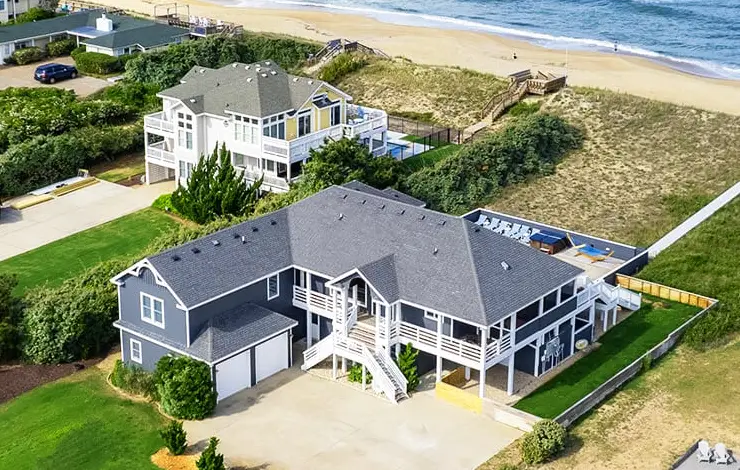
Beach houses advertised on Airbnb and VRBO routinely feature pools, hot tubs, beach access stairs, decks, dunes, and sometimes private docks or boat slips. Amenity profile drives both guest selection and claim severity — and most underwriters specifically rate coastal beach houses for the combination of amenity exposure and high guest turnover. III.org’s overview of hurricane and windstorm deductibles documents how combined wind-and-water claims at coastal STRs run materially higher than ordinary residential losses.
5. Dune, erosion, and coastal lot exposure
Beach houses on or near dunes face exposure most inland property forms don’t contemplate: erosion-driven lot loss, dune permit compliance, beach access easement liability, and structural vulnerability tied to dune protection. Some states (Florida, North Carolina) regulate dune work tightly; insurance underwriting reflects the regulatory friction. Owners considering beach-front property purchase should confirm the dune designation and any building setbacks at the lot before placing coverage.
Common Beach House STR Claims We See
Hurricane wind damage to roof and exterior cladding
A Cat-2 or Cat-3 hurricane tears roofing material and exterior cladding from a Florida beach house Airbnb listing. Property responds, subject to the named-storm deductible. Severity routinely runs $40,000–$200,000 on partial losses and $400,000+ on total or near-total losses. Code-driven rebuild premium adds another 20–40% on older properties — Ordinance & Law covers that gap.
Storm surge damage to ground floor
Storm surge floods the ground level of an Outer Banks beach house VRBO listing during a Cat-2 hurricane. Flood — not property — responds; structural water damage, finishes, and ground-floor contents are total losses. NFIP and private flood combined typically settle in the $150,000–$400,000 range on a substantial ground-floor flood. The coverage gap between NFIP’s $250K building cap and actual replacement cost is the most common claim-time surprise.
Pool deck slip-and-fall
A guest at a Gulf Coast beach house slips on a wet pool deck and fractures an ankle. The claim alleges inadequate non-slip surfacing and pool-area lighting. General Liability responds; settlements run $15,000–$75,000 typical, with material defense costs on contested claims. Beach houses with multi-level pool decks and outdoor staircases see this claim pattern most frequently.
Hurricane evacuation business interruption
A mandatory hurricane evacuation cancels the upcoming weeks of bookings at a Florida beach house Airbnb listing. Civil-authority coverage on the loss-of-rents policy may respond if tied to a covered loss in the area — typically for 2–4 weeks. Beyond that window, cancelled-booking income is generally not covered without a specific civil-authority extension endorsement.
Dock or pier damage from a storm
Wind and wave action damages a private dock or pier at a coastal beach house STR. Other Structures coverage responds with separate sub-limits — typically 10% of dwelling — and dock-specific exclusions on some forms reduce coverage further. Severity ranges $8,000–$50,000 depending on dock size, construction, and damage extent.
Why Beach House STR Operators Choose STR Guard
We work with the coastal carrier panel. Beach house STR coverage requires specialty carriers — admitted, surplus lines, and state residual markets (Citizens, Beach Plan, SC Wind & Hail, TWIA) working in combination. We work with carriers in the STR specialty market that have priced for coastal exposure and that understand how named-storm deductibles, flood policies, and primary property coverage layer together.
We coordinate wind + flood + property as a program. Coastal coverage isn’t one policy — it’s typically three or four working together. Getting the layering right (deductible structure, coverage attribution between wind and flood at claim time, ordinance and law on older properties, extended period of restoration on long rebuild timelines) is the difference between a clean claim outcome and a costly gap.
We navigate state residual markets. Florida Citizens, the North Carolina Beach Plan, the South Carolina Wind and Hail Underwriting Association, and Texas TWIA each have different eligibility rules, coverage scopes, and depopulation patterns. We work the residual-market piece of coastal beach house programs in coordination with the admitted and surplus lines coverage for the remaining perils.
We respond in 1–2 hours during business hours. Coastal quote requests submitted through the STR Guard quote form are typically returned within 1–2 hours during business hours. Coastal multi-policy placements (property + flood + umbrella) may take additional time, but you’ll hear back from us the same business day.