What Vacation Rental Insurance Costs
"Vacation rental insurance" is the broad category that covers any property operated for short-term rental — single-family homes, beach houses, cabins, condos, multi-unit properties. The actual policy form depends on the property type and operating model: a part-time vacation rental on a single-family home typically uses a DP-3 dwelling form, while a full-time multi-property vacation rental operation moves to commercial habitational. Tax treatment follows the same logic — the IRS treats rental property income as a business activity under Topic 414: Rental Income and Expenses. The coverage program a vacation rental owner typically needs runs across six lines:
- General Liability: Guest bodily injury and third-party property damage. Typical limits $1,000,000 each occurrence / $2,000,000 aggregate. See General Liability for STR.
- Property / Dwelling: The structure. DP-3 for most single-property vacation rentals; commercial habitational for full-time or multi-property operations. See Property / Dwelling coverage.
- Loss of Rents: Rental income during a covered loss. Critical for vacation rentals where seasonal peaks generate disproportionate revenue. See Loss of Rents — also frequently called business income insurance on commercial forms.
- Contents and Furnishings: The furnishings, electronics, kitchenware, and linens that make the property rentable. Fully-furnished vacation rentals carry $80K–$200K in real replacement cost — well above the 50%-of-dwelling default. See Contents coverage.
- Flood Insurance: Standard property policies exclude flood. Coastal and inland flood-zone vacation rentals need separate flood coverage through NFIP or the private market. See FloodSmart.gov for the federal program overview.
- Umbrella / Excess (optional but recommended): Higher liability limits over primary GL. Advisable for properties with pools, hot tubs, or high guest capacity. See Umbrella coverage.
Premium varies sharply by property type, location, claims history, amenity profile, and operating model. Coastal markets and properties in mapped flood zones price higher than inland markets; full-time STRs price higher than part-time. For context on how vacation rental market conditions affect underwriting, see AirDNA’s vacation rental market research, which tracks ADR (average daily rate), occupancy, and supply across major STR markets.
Vacation Rental Regulation by State
Vacation rental regulation is genuinely state-by-state — and within most states, city- and county-by-city. Some jurisdictions impose state-level registration; others rely entirely on local zoning. The variation affects both compliance burden and underwriting, since regulatory risk factors into carrier appetite for the property.
- Florida: The state explicitly uses the term "vacation rentals" in its regulatory framework. Properties must register with the Florida Department of Business and Professional Regulation (DBPR). State-level registration is required in addition to any city-specific overlays (Miami Beach, Orlando, Destin, Key West).
- California: The California Department of Insurance regulates the insurance side; city and county rules (San Francisco primary-residence requirement, Los Angeles home-sharing ordinance, Santa Monica’s strict limits) govern operations. California is one of the more complex jurisdictions for vacation rental compliance.
- Tennessee: No state-level vacation rental registration, but Nashville Metro’s Type 1 / Type 2 ordinance materially affects properties in the largest market. The Tennessee Department of Commerce and Insurance regulates carriers and rate filings.
- Texas: No state-level vacation rental registration; Austin and other major cities impose their own licensing rules. The Texas Department of Insurance handles state insurance regulation.
If your vacation rental operates across multiple jurisdictions — a Florida coastal beach house plus a Nashville Type 2 single-family STR plus a Colorado mountain cabin — the regulatory and insurance picture gets more complex fast. We work with operators in that position routinely.
What Makes Vacation Rental Insurance Different
Vacation rental insurance sits across all STR property types. The unifying thread isn’t the building — it’s the operating model. Five specific underwriting realities apply broadly to any property operated as a vacation rental.
1. Platform-driven booking model
Properties listed on Airbnb, VRBO, and Booking.com are evaluated by carriers as small businesses, not residences. The platform model creates a paper trail (booking history, payout records, guest reviews, message logs) that carriers use for underwriting and that adjusters can reference at claim time. III.org’s overview of peer-to-peer home rental insurance consistently flags the platform-driven model as the foundational distinction from standard residential coverage.
2. Seasonal occupancy patterns and income volatility
Vacation rentals concentrate revenue in peak weeks — summer for beach houses, winter for ski-area cabins, spring break for desert and resort markets. A covered loss during a peak week can wipe out a full year of expected income; loss-of-rents coverage needs to be sized for daily rate × covered days, not a flat monthly figure. Carriers expect booking-history documentation pulled from Airbnb and VRBO host dashboards to support claim valuation.
3. Guest selection without standardized application
Traditional landlord business runs every applicant through the same screening — credit check, rental history, income verification. Vacation rental hosts evaluate each booking individually, often based on inferred information from a profile photo, name, or message. The decision pattern creates fair-housing exposure (covered by tenant discrimination liability) that standard landlord policies don’t anticipate, and a higher rate of guest-related claims per dollar of premium than long-term rental.
4. Higher claim frequency than long-term residential
High guest turnover puts more unique individuals on the property per year than a single long-term tenant. Guests are unfamiliar with the property layout, appliances, and amenities, which elevates slip-trip-fall and guest-caused damage frequency. III.org guidance on insuring a vacation home consistently flags this frequency gap as the primary reason standard homeowners coverage falls short for vacation rental use.
5. Multi-jurisdiction regulatory complexity
Vacation rental operators frequently hold properties across multiple states and cities. Each jurisdiction has its own registration requirements, occupancy taxes, zoning rules, and platform-specific compliance demands. The complexity scales fast for portfolio operators; for single-property owners, even one property can sit at the intersection of state, county, and city rules that each affect coverage decisions.
Common Vacation Rental Claims We See
Slip-and-fall at a coastal beach house
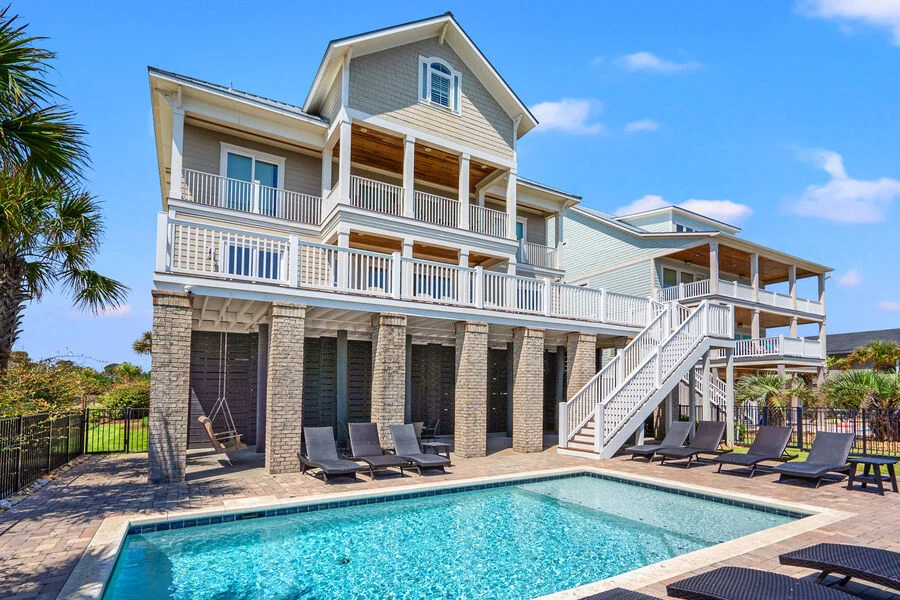
A guest at a Florida beach house Airbnb listing slips on a pool deck or wet outdoor staircase and is injured. The claim alleges inadequate non-slip surfacing or insufficient lighting. General Liability responds; severity ranges $15,000–$75,000 with significant defense costs on contested claims.
Fire damage at a mountain cabin off-season
An electrical fault sparks a fire at a Colorado mountain cabin VRBO listing during the off-season between bookings. Property covers structural repair; loss-of-rents responds for the cancelled peak-season bookings during the rebuild period. Severity routinely runs $80,000–$250,000 on total or near-total losses.
Theft from an urban condo vacation rental
A departing guest steals electronics and small furnishings from a condo Airbnb listing. Contents responds, subject to theft sub-limits and police-report documentation. Severity runs $3,000–$15,000 depending on item profile.
Hurricane damage at a Florida vacation rental
A Cat-2 hurricane damages a Florida coastal vacation rental — roof, exterior cladding, contents. Property responds, subject to the named-storm deductible (typically 1–5% of dwelling). Loss-of-rents covers cancelled bookings during the rebuild — often extending past the standard 12-month period of restoration cap, which is why an Extended Period of Restoration endorsement matters for coastal properties.
Guest party damage at a single-family STR
A guest party at a single-family VRBO listing damages flooring, fixtures, and the neighbor’s fence. Property covers the on-premises damage; General Liability responds for third-party property damage to the neighbor. Combined severity routinely $10,000–$40,000.
Why Vacation Rental Operators Choose STR Guard
We write across all vacation rental property types. Beach houses, mountain cabins, single-family STRs, condos, multi-unit operations — vacation rental insurance spans the full property-type range, and the right form depends on the property as much as the operating model. We work with carriers that cover the full spectrum, not just one slice.
We work with the right specialty carriers. Vacation rentals are a distinct underwriting category — the carrier panel that writes them well isn’t the homeowners or landlord panel. We work with carriers in the STR specialty market that have priced for platform-driven booking exposure, amenity profile, and seasonal income concentration.
We help with multi-jurisdiction coordination. Operators with vacation rentals across multiple states face overlapping registration, tax, and zoning requirements. We coordinate coverage decisions with the regulatory picture in each jurisdiction, including state-specific carrier appetite differences.
We respond in 1–2 hours during business hours. Quote requests submitted through the STR Guard quote form are typically returned within 1–2 hours during business hours. Complex multi-property quotes may take longer, but you’ll hear back from us the same business day.