Short-term rental insurance in Arizona sits on a two-layer rulebook. State law bars cities from banning vacation rentals outright, but it allows those cities to license and regulate them, and a separate state tax license applies. Most Phoenix, Scottsdale, and Sedona hosts need a policy written for paid guest occupancy rather than a homeowners form, which typically excludes the operation.
That structure explains a lot of confusion in this market. Hosts hear that Arizona protects short-term rentals and conclude there is nothing to comply with. The opposite is closer to true.
Why an Arizona STR Needs More Than a Homeowners Policy
A homeowners form is priced for a household living in a house. A short-term rental hands keys to strangers on a nightly cycle, and most homeowners forms either exclude that use or restrict it until the coverage stops meaning much. Our comparison of STR coverage against landlord insurance walks through why an annual-lease form does not close the gap either.
The failure mode is consistent. A carrier that learns of undisclosed hosting after a loss may deny the claim, non-renew, or both. In Arizona that discovery is easy, because permits are public, tax licenses are on file, and license numbers appear in listings.
Most hosts end up with three moving parts: general liability for guest injury and third-party property damage, a property form that expects turnover rather than continuous owner occupancy, and loss of rents to replace booking income when a covered loss takes the home off the calendar. Vacation rental coverage is the general shape; single-family STR coverage is the common Arizona specific.
State Preemption and the Local Permit Layer That Still Applies
Arizona settled the question of whether a city can outlaw your rental. Under A.R.S. § 9-500.39, cities and towns may not prohibit vacation rentals or short-term rentals. The same statute is explicit about what cities may still do: require an owner to obtain and maintain a local regulatory permit or license, enforce rules protecting public health and safety, apply zoning ordinances, require an emergency contact, require neighbor notification, and require the permit number to appear on advertisements.
Layered on top of that is the tax license. Per the Arizona Department of Revenue, short-term residential rentals are lodging stays of less than 30 days, that income is subject to transaction privilege tax, and a property owner may also need a business license from the city where the residence is located — which the department is explicit is a different thing from the state tax license.
So there are two layers, and hosts routinely satisfy one and assume it covered the other. Because these requirements change, verify the current rules with both the state and the governing city rather than relying on any summary, including this one. Our state-by-state STR permit and licensing guide covers how Arizona compares to other states.
The Liability-Insurance Expectation Written Into Arizona’s Rules
Most states leave insurance entirely to the host. Arizona wrote it into the framework. Under the same statute, a city may require that a vacation rental maintain liability insurance appropriate to cover the rental, or that the owner operate through an online lodging marketplace offering equivalent coverage.
Cities have taken that authority up. The City of Scottsdale, for example, publishes a vacation and short-term rental program that requires a city license for any property offered for rent for fewer than 30 days and maintains a neighbor notification and liability insurance compliance attestation as part of the process.
Two practical points follow. First, an attestation is a statement you sign, which means the coverage behind it needs to actually respond to paid guest occupancy rather than merely exist. Second, the marketplace alternative is narrower than it sounds: platform host protection applies to bookings made through that platform, which leaves direct bookings outside it, and it does not insure the structure between guests. Hosts who take direct reservations should not treat the marketplace option as their answer.
Phoenix: Urban and Suburban Scale
Phoenix is the volume market. The inventory runs from downtown condominiums to midcentury ranch homes to large suburban houses on the edges of the metro, and that range means there is no single Phoenix property profile for an underwriter to price against.
What is consistent is the exposure mix. Pools are common across price points. Cooling systems carry the whole summer. And in a market this large, the operational questions — how access is controlled, how turnover is managed, whether the host lives nearby — matter more than they do where inventory is scarce and professionally managed.
Hosts operating several Phoenix-area properties should also check how their limits are structured. Separate policies on each address behave differently at claim time than a single program written across the schedule.
Scottsdale: Resort Inventory and Event Restrictions
Scottsdale inventory skews toward resort-style homes: pools, spas, outdoor kitchens, and layouts built for entertaining. That profile pulls two underwriting questions to the front — the water features, and the size of the groups the property is marketed to.
It also puts hosts in the path of a specific local rule. Scottsdale ordinances prohibit short-term rentals from being used for weddings, corporate events, large parties, and other commercial gatherings, on the basis that these properties are intended for residential use. That is a compliance rule, but it has an insurance shadow: a host who accepts an event booking may be operating outside both the city ordinance and the description on their own insurance application at the same time.
Where a property is marketed to larger groups, an umbrella layer sitting above the underlying liability limit is worth pricing rather than assuming.
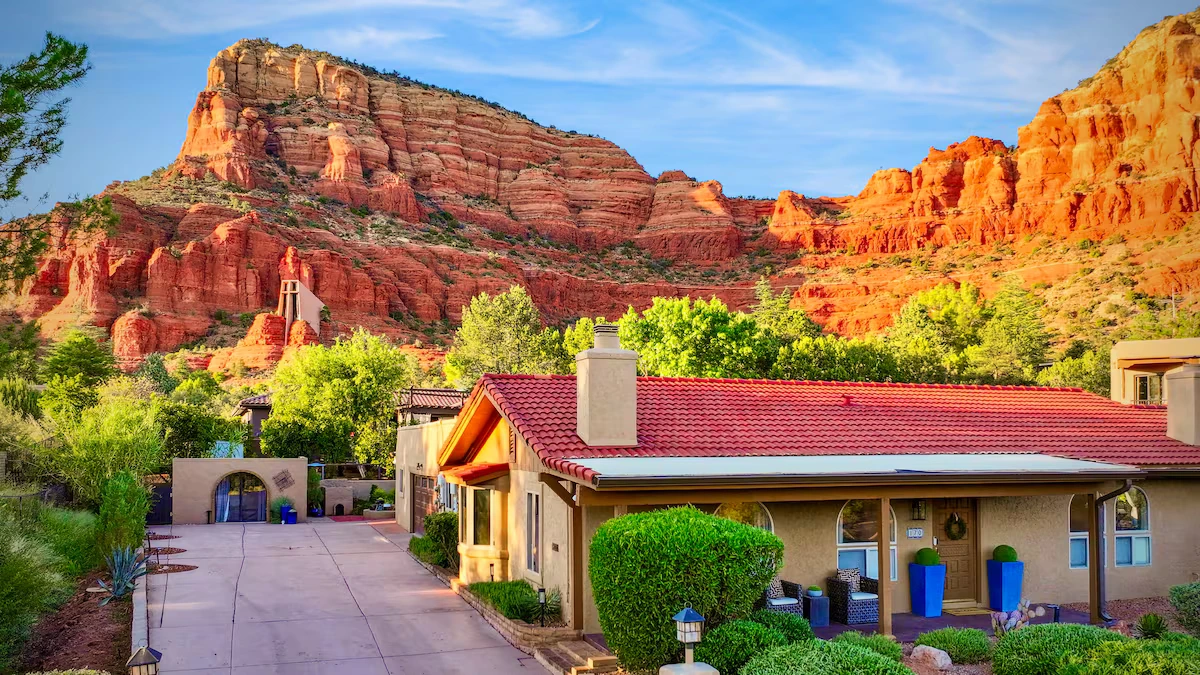
Sedona: A Small-Inventory Tourism Market
Sedona is a different animal from either metro. The inventory is small, the visitor economy is concentrated, and the properties tend to be individually distinctive rather than one of a hundred similar homes on the same street.
That has two coverage consequences. The first is valuation: distinctive construction, custom finishes, and site-specific building conditions make replacement cost harder to estimate and more important to get right. The second is repair timelines. In a smaller market with fewer contractors, the gap between a covered loss and a reopened calendar can run long, which is a loss-of-rents question rather than a property one. Hosts here should look closely at how their rental income is measured and how long that coverage runs.
Pool and Spa Liability: Arizona’s Dominant Exposure
Across all three markets, one exposure sits above the others. A pool or spa concentrates drowning and injury risk in an area guests use without supervision, at hours the host is not present, and often after drinking.
Underwriters look for physical controls: perimeter fencing, self-closing and self-latching gates, alarms, adequate lighting, depth markings, and a functioning spa cover. They also read the listing, because a listing that markets the pool to large groups describes a different operation than one that mentions it in passing.
Scenario: a four-bedroom home with a pool and a heated spa
We worked with an owner who bought a single-story home with a pool, a spa, and a shaded outdoor kitchen, then listed it for multi-family stays. The city license was in place and the tax license was filed. The insurance, though, had been carried over from the purchase — a homeowners-style form, a liability limit set for an owner-occupied house, and no mention anywhere in the file that guests were paying to stay there.
Nothing had gone wrong, which is the only reason the correction was clean. We rewrote the property onto a form built for paid guest occupancy, matched the advertised capacity to what the host actually accepted, documented the pool fencing and gate hardware in the submission rather than leaving an underwriter to imagine them, and added an umbrella layer sized to the group profile. Had a guest been injured at the spa during one of those bookings, the argument would have been about whether coverage applied at all rather than about how much of it there was.
Heat, Monsoon Season, and the Property Side
The Arizona property conversation is seasonal in a way hosts underestimate. Cooling systems run hard for months and fail under load, usually with a full house and no relief available. Equipment breakdown coverage addresses mechanical and electrical failure of systems including air conditioning and is generally not part of a standard property form. Whether the resulting cancellations are covered is a separate question that turns on how the form defines a covered cause.
Monsoon season adds the rest. Dust storms and high winds damage roofs, walls, and landscaping. Flash flooding moves through washes and low-lying areas well away from anything most people picture as a floodplain — and flood is excluded from essentially every standard property policy, so it is bought separately through a flood policy. Confirm the flood zone rather than assuming the absence of a nearby river settles it.
Comparing the Three Arizona Markets
The rulebook is shared. The property profiles are not.
| Consideration | Phoenix | Scottsdale | Sedona |
|---|---|---|---|
| Inventory character | Broad range, urban through suburban | Resort-style homes built for entertaining | Small, distinctive, tourism-driven |
| Dominant liability driver | Pools across price points, access control | Pools, spas, and larger guest groups | Guest activity and site conditions |
| Local rule to watch | City business license requirements | Restrictions on events and commercial gatherings | Local permit rules in a small market |
| Main property concern | Cooling system load and building age | Replacement value of finishes and amenities | Valuation and repair lead times |
| Typical loss-of-rents trigger | Repair displacement year-round | Repair displacement during peak season | Extended repair timelines |
For the statewide view, see the Arizona STR insurance cost guide and our Arizona location page.
Getting Arizona Coverage Placed
Work the sequence in order. Confirm which city governs the parcel and what it requires, then confirm the state tax license is filed and current. Disclose the short-term rental use in writing to whoever writes the policy, every time. Match the capacity on your application to the capacity you actually advertise and accept. Document the pool and spa controls rather than describing them vaguely. Then check whether equipment breakdown, flood, loss of rents, and an umbrella layer are present rather than assumed.
Rules and requirements change, so treat the state and the governing city as the authorities over any summary, including this one, and take insurance-regulatory questions to the Arizona Department of Insurance and Financial Institutions. If you would rather someone else run the sequence, we can look at your property directly.
Frequently Asked Questions
Do I need special insurance for a short-term rental in Arizona?
Typically yes. A homeowners policy is written for a residence the owner occupies, and most forms exclude or sharply restrict the paid transient occupancy that defines a short-term rental. Arizona hosts generally need liability written for guest injury paired with a property form that expects turnover. State law also contemplates that cities may require vacation rentals to carry liability coverage appropriate to the use.
Can a city in Arizona ban my short-term rental?
No. Arizona law provides that cities and towns may not prohibit vacation rentals or short-term rentals outright. What cities can do is require a local regulatory permit or license, enforce health and safety rules, require an emergency contact, and restrict certain uses. Those local requirements are real obligations, so confirm the current rules with the city that governs your property before you list it.
Do I need a license for a short-term rental in Phoenix, Scottsdale, or Sedona?
Usually two of them. Arizona requires a transaction privilege tax license from the state for lodging stays under 30 days, and the city where the property sits may separately require its own business license or short-term rental permit. The two are different filings with different issuers. Confirm both with the state revenue department and the city before your first booking.
Does my Arizona short-term rental policy cover pool injuries?
It depends on the liability form and the limit. A pool or spa is the most common reason an Arizona property draws underwriting follow-up, because it concentrates drowning and injury exposure in an area guests use unsupervised. Fencing, self-latching gates, alarms, lighting, and posted rules affect how the risk is viewed and sometimes whether it is written at all.
Is short-term rental insurance more expensive in Scottsdale or Sedona than Phoenix?
There is no reliable general answer, and any guide offering one is guessing. Resort-style inventory tends to raise the questions that move pricing, such as pool and spa exposure, higher replacement values, and larger guest groups. But construction, age, claims history, capacity, and rental frequency vary so widely within each market that two homes in the same city can price very differently. Get quotes on the actual property.
Do I need flood insurance for an Arizona short-term rental?
It is worth checking regardless of whether a lender requires it. Flood damage is excluded from essentially every standard property policy and is bought separately. Arizona monsoon storms produce flash flooding in washes and low-lying areas well away from anything most people would call a floodplain. Confirm the flood zone your property sits in before assuming you are outside one.
The Bottom Line on Arizona STR Insurance
Arizona gives short-term rental hosts something most states do not: a statutory floor that keeps a city from banning the use outright. What it does not give them is a pass on the licensing layer. A state tax license and a city permit are separate obligations with separate issuers, and both show up in an underwriting file. Treat compliance and coverage as one workflow rather than two errands months apart.
On the coverage side, the pattern across Phoenix, Scottsdale, and Sedona is consistent even though the inventory is not. Pools and spas drive liability. Heat and cooling-system failure drive the property conversation. Monsoon season drives the flood and storm conversation. Get those three right and you have addressed most of what actually goes wrong here. The Arizona STR insurance cost guide covers the statewide picture, and we are glad to look at your specific property through the quote form.