Short-term rental insurance in Las Vegas starts with a question most guides never ask: which government licenses your address. Unincorporated Clark County and the valley’s incorporated cities run separate regimes, and that answer shapes the placement. Most hosts here need a policy written for paid guest occupancy rather than a homeowners form, which typically excludes the operation outright.
The licensing question is not administrative trivia. It is the first thing a specialty underwriter checks, and it is why two similar valley homes can be quoted on very different terms.
Why a Las Vegas STR Policy Starts With the License
A homeowners form is priced for a household living in a house. A short-term rental hands keys to strangers on a nightly cycle, and most homeowners forms either exclude that use or restrict it until the coverage stops being meaningful.
The failure mode is consistent. A carrier that discovers undisclosed hosting after a loss may deny the claim, non-renew the policy, or both. What makes the valley distinctive is that licensing here is not casual. A licensed operation is documented, inspected, and tied to a specific parcel, which means a carrier can verify the story your application tells.
Most hosts end up with three moving parts: general liability for guest injury and third-party property damage, a property form that expects turnover rather than continuous owner occupancy, and loss of rents to replace booking income when a covered loss takes the home off the calendar.
Clark County or the City: Two Regimes in One Valley
The Las Vegas metropolitan area is not one jurisdiction. Large stretches of what people call Las Vegas are unincorporated Clark County, and the incorporated cities in the valley set their own rules.
Per the Clark County short-term rental licensing program, the county materials apply to unincorporated Clark County and the requirements are codified in Chapter 7.100 of the Clark County Code. The county did not adopt that framework on its own initiative — as Clark County explains, Assembly Bill 363 required the county to enact an authorizing ordinance and set the baseline for components including distance requirements between homes, fees, and penalties.
For a host, the practical consequence is that a mailing address is not a jurisdiction. Two homes on either side of a boundary line can face different applications, different rules, and different compliance obligations. Before you shop coverage, confirm which authority actually governs your parcel. Because these rules change, verify current requirements directly with the governing jurisdiction rather than relying on any summary, including this one. Our state-by-state STR permit and licensing guide covers the wider pattern.
Limited Licenses, Separation Distance, and Primary Residence
The valley did not open licensing without limits. The county program runs through defined application windows rather than continuously, and at the time of writing the county states that the application period for short-term rental units is closed. State law also directed the county to set minimum separation distances between licensed rentals, and the county framework contemplates the operator’s relationship to the home rather than treating every applicant the same.
Three insurance consequences follow. First, a license here is scarce and address-specific, which makes it an asset worth confirming rather than assuming at purchase. Second, an application that describes an operation the jurisdiction has not authorized is an application a carrier may later treat as inaccurate. Third, the owner-occupancy posture changes which form fits: a host renting part of a home they live in is a different risk from an investor operating a whole house they never occupy. Those are owner-occupied STR coverage and single-family STR coverage respectively, and they are not interchangeable.
Party-House and Large-Event Liability
Nowhere else does a short-term rental underwriter ask about gatherings the way they ask here. This is a destination market for celebrations, and the property type that draws the highest bookings — a large house with a pool and outdoor space — is also the property type most likely to host a group larger than the listing contemplated.
That exposure runs down two separate tracks. The liability track is guest injury and injury to people the guest invited, which is where limits matter and where an umbrella layer above the underlying liability limit earns its place. The property track is damage — broken fixtures, ruined flooring, and the vandalism and malicious mischief language that decides whether a form responds at all. Our guide to handling a guest damage claim walks through how those claims actually get documented.
If alcohol is furnished rather than merely permitted, that is a separate conversation. Furnishing alcohol can pull a host toward exposures a standard liability form was not written for, which is what liquor liability coverage addresses.
Pools, Spas, and the Supervision Gap
A pool is the single most common reason a valley property draws underwriting follow-up. It concentrates drowning and injury exposure in an area guests use without supervision, at hours the host is not present, often after a long day and sometimes after drinking.
Underwriters look for the physical controls: fencing, self-closing and self-latching gates, alarms, adequate lighting, depth markings, and whether a spa has a functioning cover. They also look at the listing, because a listing that markets the pool to large groups describes a different operation than one that mentions it in passing.
Scenario: a five-bedroom valley home with a large pool
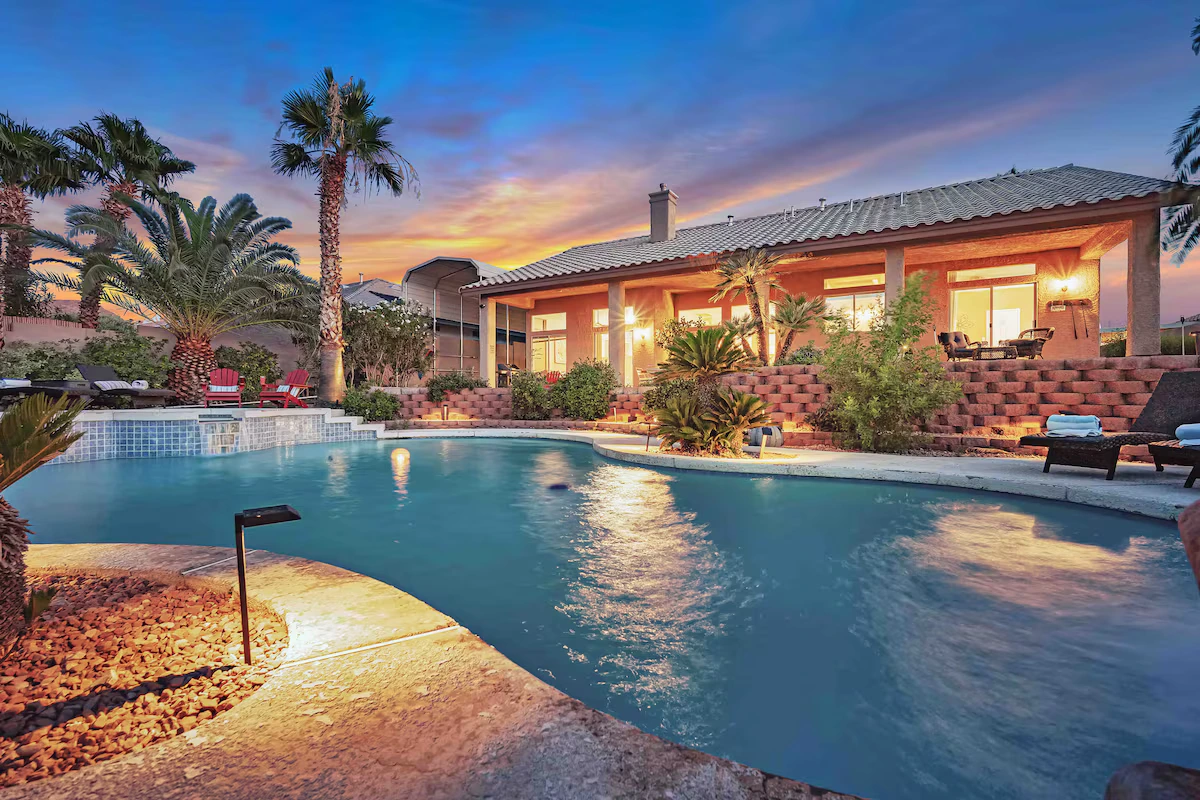
We worked with a host who bought a single-story home with a resort-style backyard and listed it for large groups. The property was licensed, the pool was fenced, and the host carried a liability limit that had been set years earlier for a much smaller house. The listing photos, meanwhile, showed the pool as the centerpiece and the calendar filled with multi-family bookings.
Nothing had gone wrong, which is the only reason the correction was straightforward. We rewrote the property onto a form built for paid guest occupancy, matched the advertised capacity on the application to what the host actually accepted, added an umbrella layer sized to the group profile, and documented the pool controls in the submission rather than leaving an underwriter to imagine them. Had a guest been injured at the pool during one of those bookings, the argument would have been about limits rather than about whether coverage applied at all.
Extreme Heat, HVAC Failure, and the Property Side
The property conversation in this market is dominated by heat. Cooling systems here run hard for months, and they fail at the worst possible moment — a full house, peak season, no relief available.
Two coverage pieces get overlooked. The first is equipment breakdown, which addresses mechanical and electrical failure of systems such as air conditioning and is generally not part of a standard property form. The second is what happens next: if the failure makes the home unrentable and forces cancellations, that is a loss-of-rents question, and whether it responds depends on how the form defines a covered cause. Hosts who assume a broken compressor is simply a maintenance cost are usually right about the repair and wrong about the cancelled bookings.
Roof and exterior damage from seasonal storms belongs in the same conversation, along with confirming whether water backup and other endorsements are present rather than assumed.
Heat also changes how a property behaves between guests. Interior finishes, adhesives, and sealed appliances age faster under sustained cooling loads, and a home that sits vacant with the thermostat pushed up can develop problems no one sees until the next guest arrives. Hosts running a heavy summer calendar are typically better served by scheduling mechanical inspections around the season rather than reacting after a failure, because the coverage question is always easier to answer when the maintenance record is clean and the property was demonstrably being looked after.
How Las Vegas Compares to the Rest of Nevada
Nevada is not one short-term rental market, and the valley sits at a distinct corner of it.
| Consideration | Las Vegas valley | Nevada mountain and lake markets | Small-town and rural Nevada |
|---|---|---|---|
| Primary regulatory gate | Jurisdiction-specific license, limited availability | Local rules that vary sharply by town | Often lighter local requirements |
| Dominant liability driver | Large gatherings and pool exposure | Guest activity and shared amenities | Property access and site conditions |
| Main property concern | Cooling system failure and heat load | Seasonal weather exposure | Distance to fire service |
| Dominant guest profile | Groups traveling for events and celebrations | Leisure and seasonal visitors | Mixed leisure and work travel |
| Typical loss-of-rents trigger | Repair displacement during event weekends | Seasonal booking loss | Repair displacement year-round |
For the statewide view, see the Nevada STR insurance cost guide and our Nevada location page.
Getting Las Vegas Coverage Placed
Work the sequence in order. Confirm which jurisdiction governs the parcel, then confirm the license status is current and in your name. Disclose the short-term rental use in writing to whoever writes the policy, every time. Match the capacity on your application to the capacity you actually advertise and accept. Document the pool controls rather than describing them vaguely. Then check whether equipment breakdown, loss of rents, and an umbrella layer are present rather than assumed.
Rules and requirements change, so treat the Nevada Division of Insurance and the licensing jurisdiction’s own pages as the authorities over any summary, including this one. If you would rather someone else run the sequence, we can look at your property directly.
Frequently Asked Questions
Do I need special insurance for a short-term rental in Las Vegas?
Typically yes. A homeowners policy is written for a residence the owner occupies, and most forms exclude or sharply restrict the paid transient occupancy that defines a short-term rental. Las Vegas area hosts usually need liability written for guest injury paired with a property form that expects turnover. Because the valley licenses these properties, the hosting activity is not something a carrier has to guess at.
Who licenses a short-term rental in Las Vegas, the city or the county?
It depends on the address. Unincorporated Clark County runs its own licensing program under the county code, and the incorporated cities in the valley have separate rules of their own. A property a few streets away from yours can sit under a different authority entirely. Confirm which jurisdiction your parcel falls in before you apply for anything or buy a policy.
Does homeowners insurance cover an Airbnb in Las Vegas?
Often it does not, and the gap usually surfaces at claim time rather than at purchase. Once a property is listed for paid transient stays, many carriers treat it as a business use the homeowners form was never priced for. Some carriers will decline a claim or non-renew when they learn of undisclosed hosting. Disclosing the use up front is what keeps the policy enforceable.
Do I need extra liability coverage for a Las Vegas rental with a pool?
It is usually worth pricing. A pool or spa is the single most common reason an underwriter asks follow-up questions on a valley property, because it concentrates injury and drowning exposure in an area guests use unsupervised. Fencing, gates, alarms, and posted rules affect how the risk is viewed. An umbrella layer above the underlying liability limit is a common answer.
Does my policy cover damage from a party at my short-term rental?
It depends entirely on how the form is written. Damage caused by guests may be handled differently than damage caused by people the guest invited, and some forms exclude or sub-limit losses tied to events. Large-gathering exposure is a defining underwriting question in this market, so read the vandalism, malicious mischief, and liability language before you assume it responds.
How much does short-term rental insurance cost in Las Vegas?
There is no single Las Vegas number, and any guide quoting one is guessing. Pricing moves with construction and age, guest capacity, whether a pool or spa is on site, claims history, licensing status, and how much of the year the property is rented. A licensed owner-occupied home and an investor-held property with a large pool may price very differently. Get quotes on the actual property.
The Bottom Line on Las Vegas STR Insurance
Las Vegas is a licensed market before it is an insurance market. Which government regulates your address determines what you have to obtain, what you can advertise, and what an underwriter reads when your application arrives. Hosts who work licensing and coverage as one workflow tend to encounter far fewer surprises than hosts who handle them separately, months apart.
On the coverage side, this market has a signature. Large gatherings and pools drive the liability conversation, and extreme summer heat drives the property conversation through cooling systems that fail exactly when they are needed most. Get liability limits and the mechanical-failure piece right and you have addressed most of what actually goes wrong here. If you want to see how the valley compares with the rest of the state, the Nevada STR insurance cost guide walks through the statewide picture, and we can look at your property through the quote form.