General liability insurance for short-term rentals covers third-party bodily injury, third-party property damage, and the legal defense costs that come with a guest claim during a stay. Standard STR limits are $1 million each occurrence and $2 million aggregate. STR general liability is structurally different from homeowners liability for three reasons: carriers classify STR operations as commercial, guest amenities create exposure homeowners forms exclude, and underwriting is driven by frequency of occupancy.
What General Liability Actually Covers for STR Properties
General liability insurance is the coverage that responds when someone who is not you — a guest, a guest’s visitor, a delivery driver, a neighbor — is hurt or has their property damaged in connection with your rental, and you are legally responsible. On a short-term rental, it is built on the same architecture as the commercial general liability (CGL) form carriers write for any small business: the ISO Commercial General Liability coverage form is the industry template most STR liability sections are modeled on.
A GL policy does three jobs. First, it pays third-party bodily injury — a guest slips on a wet pool deck after midnight, a child falls on an open staircase, a guest is burned by a faulty water heater. Second, it pays third-party property damage you are legally responsible for — a tree on your lot falls onto a neighbor’s car, or a plumbing failure you knew about damages an adjoining unit. Third, and most underrated, it pays legal defense costs: attorney fees, expert witnesses, and court costs. On most policies, defense is paid in addition to the limit, which means a groundless suit does not erode the money available to actually settle a claim.
Most STR policies also fold in a small medical payments amount — commonly $1,000 to $5,000 — that pays minor guest medical bills with no finding of fault. It is a goodwill tool: a guest twists an ankle, you pay the urgent-care bill, and a small gesture keeps a nuisance event from becoming a liability suit. GL is the liability half of an STR program; the property and dwelling coverage on the building itself is the other half, and the two do not overlap.
What Standard Homeowners Liability Excludes — the Gap
The most expensive misunderstanding in this entire topic: a homeowners policy’s personal liability section does not cover short-term rental activity. Homeowners forms are written for personal, residential use. They contain a business exclusion and a rental exclusion that together remove liability coverage for bodily injury or property damage arising out of the premises being rented to others as a business — and nightly platform rental is unambiguously a business. The Insurance Information Institute’s guidance on coverage for renting out your home is direct about this: regular rental activity falls outside what a standard homeowners policy was priced and built to cover.
In our experience, this gap is invisible until a claim. A host operates an Airbnb on a homeowners policy for two years with no problem, then a guest is injured, the carrier investigates, finds a commercial rental operation that was never disclosed, and denies the liability claim — and frequently non-renews the policy on top of it. The host is then uninsured for a six-figure suit and shopping for new coverage with a claim on record.
A landlord or DP-3 dwelling policy is closer but still wrong for STR. DP-3 liability, where it is added by endorsement, is built around a long-term tenant relationship — one household, a lease, a security deposit — not nightly guest turnover, guest amenities, and the occupancy frequency of a hosted property. The structural mismatch between these forms is the whole reason STR liability exists as its own commercial product; we cover it in depth in STR insurance vs. landlord insurance and the DP-3 vs. commercial habitational comparison.
The GL-Specific Underwriting Realities for STR Hosts
STR general liability is underwritten on three inputs that homeowners liability ignores entirely: amenities, capacity, and frequency.
Amenities drive the questionnaire. Every specialty STR carrier asks a version of the same list — pool, hot tub, dock or waterfront, trampoline, ATVs or recreational vehicles, firearms on premises, dogs, and whether you offer any hosted experiences. A pool triggers the attractive nuisance doctrine: courts hold property owners to a heightened standard of care when a feature is likely to attract children, and a pool is the textbook example. We typically see carriers require a four-sided fence with a self-latching, self-closing gate, no diving board, and visible depth markings before they will write a pool property at standard terms.
Guest capacity changes appetite. A property that sleeps six is a different risk from one that sleeps sixteen. Once advertised capacity climbs above eight to ten, carriers begin to price for party risk and the simple math that more people on a deck or a staircase means more chances for an injury. Capacity above sixteen often pushes the account into the surplus lines market.
Frequency of occupancy is the input homeowners forms never ask about. Underwriters want to know how many nights per year the property rents and whether it is owner-occupied or non-owner-occupied. A property rented 250+ nights a year has materially more exposure than one rented 60 nights, and it is rated accordingly. Claims history matters here too — a single liability claim in the past three to five years moves pricing and narrows the carrier list. STR liability forms also commonly sublimit or exclude assault and battery, abuse and molestation, communicable disease, and dog bites; those are exactly the endorsements to read before binding.
Common GL Limits and Endorsements for STR Operations
The $1M / $2M Base Limit
The standard primary GL limit for a short-term rental is $1 million each occurrence and $2 million aggregate. “Each occurrence” is the most the policy pays for any single claim event; “aggregate” is the most it pays across the whole policy year. For a modest property with no high-hazard amenities, $1M/$2M is a reasonable primary layer — but read it as the floor of the program, not the ceiling.
Umbrella Stacking Above Primary GL
An umbrella policy sits on top of the primary GL and adds limit — commonly $1 million, $2 million, or $5 million, and more for larger operations. It is the single most cost-effective coverage decision an STR host makes, because umbrella limits are inexpensive relative to the protection they add. Any property with a pool, hot tub, dock, or large guest capacity should carry one. We work with hosts who insist $1 million is “plenty” right up until they see what a serious water or fall injury actually settles for; an umbrella is what keeps that claim from reaching personal assets.
Products and Completed Operations
The CGL form separates premises liability from products-completed operations — exposure arising from something you provided or did, rather than the condition of the premises itself. For STR hosts this is not abstract: it can reach a host-provided breakfast, a guest injured using equipment you supplied (kayaks, bikes, an e-bike), or a hosted experience you run. Confirm the products-completed operations aggregate is intact and not stripped out, especially if you provide more than a place to sleep.
Host Liquor Liability
The CGL form excludes liquor liability only for businesses that manufacture, sell, or serve alcohol for a charge — a bar or restaurant. A host who leaves a complimentary welcome bottle of wine is generally not “in the business” of alcohol, so a host-liquor situation is often covered under base GL. But “often” is not “always”: some STR liability forms add an explicit host-liquor exclusion, and any host who runs alcohol-involved hosted experiences (a wine tasting, a distillery tour) has real exposure. A host liquor liability endorsement buys back that coverage explicitly. Also confirm the named insured is correct — if an LLC owns the property, the LLC must be the named insured, and a property manager or co-host should be added as an additional insured where appropriate.
Where Hosts Typically Get GL Wrong
The same handful of mistakes account for most of the GL coverage gaps we see.
Relying on the homeowners policy. A host lists on Airbnb and assumes the existing homeowners liability follows. It does not — the business and rental exclusions remove it, and the gap surfaces only at claim time.
Buying $1 million and stopping. A host with a pool or hot tub treats the standard $1M/$2M as the finish line. For the property type most likely to produce a catastrophic injury claim, a single limit is thin.
Not disclosing amenities or true occupancy. A host omits the hot tub, or describes a 16-person property as sleeping eight, to ease underwriting. A material misrepresentation is grounds for a claim denial — the cheaper policy becomes no policy.
Getting the named insured wrong. The property is in an LLC but the policy names the individual, or a co-host operates the property with no insured status at all. When a suit names every party, the policy needs to as well.
Treating AirCover’s $1 million as their GL. It is a single Airbnb-only layer, not a program — more on that below.
Scenario: A 4-Bedroom STR With a Pool
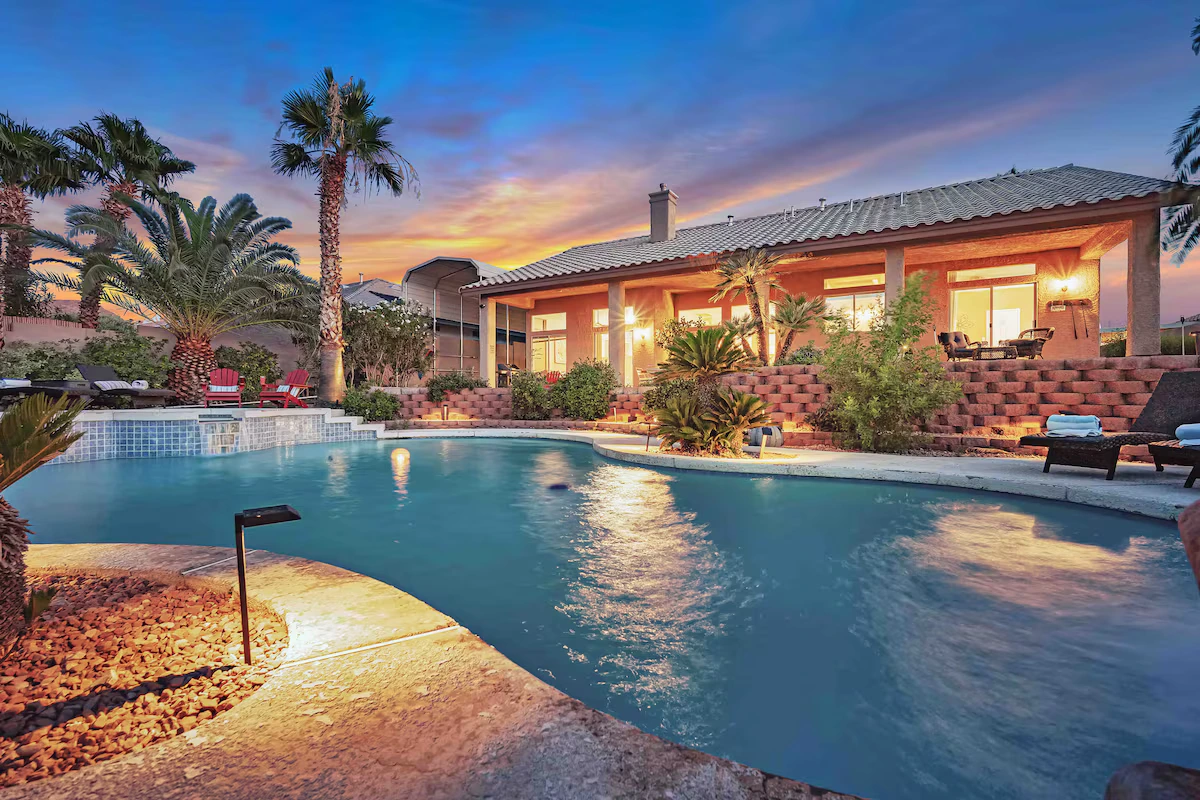
We recently helped a host with a $1.2M, 4-bedroom single-family STR — sleeps ten, private in-ground pool, hot tub, rented roughly 220 nights a year across Airbnb and VRBO. The host came to us carrying a single $1 million GL limit and no umbrella, and assumed that was a complete liability program. For a pool-and-hot-tub property at that capacity, it was not.
Pool and hot tub injuries are where STR liability claims get severe. A slip-and-fall on a wet deck commonly runs $40,000–$250,000; a serious head or spinal injury, a near-drowning, or a child’s drowning can settle anywhere from $500,000 to well past $2 million once defense costs and a sympathetic jury are factored in. A single $1 million limit can be exhausted by one event — and once it is gone, the host’s personal assets are next. We restructured the program as a layered tower: primary GL at $1M each occurrence / $2M aggregate, with a $2 million umbrella stacked above it for $3 million of total liability protection. The added umbrella premium ran a few hundred dollars a year — a small line item against the exposure it closes. The pool also had to meet the carrier’s requirements: four-sided fencing, a self-latching gate, and depth markers, all of which the property already had.
How GL Interacts With Platform Host Protection Programs
Airbnb and VRBO both bundle a liability program with hosting, and both are frequently mistaken for a substitute for real coverage.
Airbnb’s AirCover for Hosts includes $1 million in Host liability insurance, and VRBO includes $1 million in liability insurance with Vrbo-booked stays. According to the Airbnb Help Center, AirCover’s liability piece responds if a host is found legally responsible for a guest’s bodily injury or property damage during an Airbnb stay. That is a genuine benefit, included at no cost — but it has three hard boundaries. It applies only to stays booked through that platform, so a direct booking or an other-platform stay falls outside it. It is a single $1 million layer with no umbrella above it. And it excludes intentional acts and carries the same kinds of sublimits a host should be reading on any policy.
A real GL policy closes all three gaps. It responds regardless of booking channel — Airbnb, VRBO, Booking.com, or a direct reservation off your own website. It gives you a base an umbrella can stack on. And it is a policy you control, not a platform program administered on the platform’s timeline. In practice the two layer: AirCover and VRBO’s program sit as a first liability layer for platform-booked stays, and your GL responds across everything and carries the umbrella. We dig into the specifics in what AirCover actually covers and the VRBO liability insurance gaps guide.
GL is also only one piece of the program. It sits alongside property and dwelling coverage on the structure, contents coverage on the furnishings, and loss of rents for income lost during a covered closure — coverage whose 12-month restoration cap deserves its own attention. And when a guest causes the loss, the guest damage claim process determines what you actually recover. For coverage built around your property type, see our single-family STR and beach house STR pages, or review the regulatory backdrop for high-volume markets on our Florida STR page and in the Florida cost guide.
Frequently Asked Questions
What is general liability insurance for short-term rentals?
General liability insurance for short-term rentals is commercial coverage that responds when a guest or other third party is injured, or their property is damaged, in connection with a stay at your rental. It pays third-party bodily injury and property damage claims plus the legal defense costs, which on most policies are paid in addition to the limit. It is the foundational liability layer of a real STR insurance program, separate from the property coverage on the building itself.
What does general liability cover for STR properties?
GL covers third-party bodily injury (a guest falls on the pool deck, a child is hurt on a staircase, a guest is burned by a faulty appliance), third-party property damage you are legally responsible for, and the cost of defending those claims even when they are groundless. Most STR policies also include a small no-fault medical payments amount — commonly $1,000 to $5,000 — that can pay minor guest medical bills without a liability finding.
What does general liability NOT cover for short-term rentals?
GL does not cover damage to your own building or contents — that is property coverage. It also excludes intentional acts, injury to your own employees (workers’ compensation territory), professional services, and typically carries sublimits or exclusions for assault and battery, abuse and molestation, communicable disease, and dog bites. Many STR forms also restrict liquor liability. Reading the exclusions and endorsements on the actual policy matters more than the headline limit.
What general liability limits should STR hosts carry?
Standard STR general liability runs $1 million each occurrence and $2 million aggregate. In our experience, $1 million alone is inadequate for any property with a pool, hot tub, dock, or guest capacity above eight to ten — a serious water or fall injury can settle well past $1 million. Hosts with those exposures typically stack a $1–5 million umbrella above the primary GL so the program responds to a catastrophic claim.
Is general liability insurance required by law for STR properties?
No federal law requires it, but it is effectively mandatory in practice. A growing number of cities and counties require proof of liability insurance — often $500,000 to $1 million — as a condition of an STR permit, and Airbnb and VRBO require hosts to carry adequate insurance under their terms. A mortgage lender will also require liability coverage. Treat GL as required even where no statute names it.
How is general liability different for STR vs. landlord vs. homeowner?
A homeowners policy covers personal, residential use and excludes liability arising from renting the home as a business. A landlord (DP-3) policy adds liability for a long-term tenant relationship but is not built for nightly guest turnover or guest amenities. STR general liability is commercial coverage rated for high occupancy frequency, guest amenities, and the nightly-rental exposure both other forms were never designed to carry.
Does Airbnb AirCover replace general liability insurance?
No. AirCover for Hosts includes $1 million in Host liability insurance, but it applies only to Airbnb-booked stays, excludes intentional acts, and is a single $1 million layer with no umbrella above it. It does not respond to direct bookings, other-platform stays, or claims above $1 million. AirCover is a useful first layer, but a real GL policy that responds across every booking channel sits underneath it.
The Bottom Line on General Liability for STR Operators
General liability is the foundation of an STR insurance program: it pays third-party bodily injury, third-party property damage, and the defense costs that come with a guest claim. The standard $1M each occurrence / $2M aggregate limit is a starting point, not a finish line — for a property with a pool, hot tub, dock, or large guest capacity, a serious injury claim can move well past $1 million.
Three things matter most. Disclose every amenity and your true occupancy so the policy responds at claim time. Stack an umbrella above the primary general liability limit if you have any meaningful injury exposure. And do not mistake Airbnb AirCover’s $1 million for a substitute — it is a layer, not a program. To structure GL for your property, submit a quote or call 317-942-0549. We respond in 1–2 hours during business hours.